Subtotal:
$0.00


Robotic Parking: The Complete Guide to Parking Robots, Automated Valet Parking and AutoMoverBot Part Four
39. Questions to Ask a Robotic Parking Supplier
The following 48 procurement questions turn a sales discussion into an evidence request. The supplier should identify whether each answer is published, demonstrated, contractually included, certified where applicable, or yet to be engineered.
| No. | Question | Why it matters |
| 1 | What exact model, revision and configuration are proposed? | Prevents model/specification mixing. |
| 2 | Is it vehicle-moving AMR, APS, AVP or hybrid? | Defines the architecture. |
| 3 | Which wheels/support points are engaged? | Establishes mechanical interface. |
| 4 | What mass, axle-load and centre-of-gravity limits apply? | Load, brake and stability. |
| 5 | What wheelbase, track, width, length and overhang range applies? | Usable vehicle envelope. |
| 6 | What clearance/underbody restrictions apply? | Prevents contact damage. |
| 7 | Which tyres, wheels, pressures and conditions are excluded? | Handles real vehicle variation. |
| 8 | Can it handle EVs, hybrids, disabled cars or flat tyres? | Requires written boundaries. |
| 9 | What floor flatness, friction, slope and joint criteria apply? | Site acceptance. |
| 10 | What water, dust, temperature, wind and lighting limits apply? | Defines operating domain. |
| 11 | What stopping distance is proven by load/speed/slope? | Core safety evidence. |
| 12 | Which sensors are navigation versus protective safety? | Avoids sensor ambiguity. |
| 13 | What are detection fields, blind zones and test conditions? | Validates people/obstacle control. |
| 14 | What happens if an obstacle appears? | Defines safe response. |
| 15 | What happens on failed engagement? | Addresses a critical hazard. |
| 16 | What E-stops exist and who may reset? | Restart control. |
| 17 | What occurs on power failure? | Safe-state/recovery design. |
| 18 | What occurs on Wi-Fi, controller, map or localisation loss? | Fault containment. |
| 19 | How is a loaded vehicle recovered? | Prevents improvisation. |
| 20 | What manual override is permitted? | Safe intervention. |
| 21 | What checks/maintenance are mandatory? | Operational effort. |
| 22 | What are battery chemistry, charge time, life and replacement terms? | Energy planning. |
| 23 | What charging-area and battery emergency requirements apply? | Fire/electrical integration. |
| 24 | What comparable throughput has been demonstrated? | Commercial feasibility. |
| 25 | What cycle-time assumptions underpin the proposal? | ROI auditability. |
| 26 | How many robots can operate in this zone? | Scalability evidence. |
| 27 | Which people remain needed in normal/peak/degraded operation? | Labour realism. |
| 28 | What training and competence assessment is included? | Safe operation. |
| 29 | What markings, barriers and pedestrian controls are required? | Zone definition. |
| 30 | What standards/conformity documents apply to this configuration? | Avoids generic certification claims. |
| 31 | Who owns risk assessment, validation and approvals? | Accountability. |
| 32 | What software/reporting is included? | Scope clarity. |
| 33 | Is there documented API/integration support? | Integration proof. |
| 34 | How are identities, authentication and logs handled? | Cybersecurity. |
| 35 | How are updates tested and rolled back? | Change control. |
| 36 | How is remote support authorised/logged? | Third-party access. |
| 37 | What data is held and for how long? | Privacy/compliance. |
| 38 | What warranty, SLA and parts availability apply? | Support. |
| 39 | What technicians/spares/recovery gear are local? | Resilience. |
| 40 | What comparable named references can we contact? | Independent evidence. |
| 41 | Who carries handling/liability/insurance responsibility? | Risk allocation. |
| 42 | What implementation timeline/dependencies are assumed? | Schedule realism. |
| 43 | What site preparation is excluded from price? | Hidden cost. |
| 44 | What acceptance tests and remedies apply? | Objective commissioning. |
| 45 | What changes trigger revalidation? | Continuing safety. |
| 46 | What availability/intervention metrics will a pilot measure? | Evidence-led decision. |
| 47 | What is the battery/software/end-of-life plan? | Lifecycle management. |
| 48 | What would make you advise against our deployment? | Tests candour. |
40. AutoMoverBot Deployment Checklist
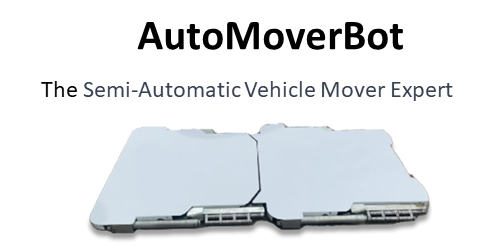
This screen is specific to the published AutoMoverBot product information but does not certify suitability. Its Model A values and troubleshooting restrictions must be reconfirmed with the supplier for the exact model and site.
| Area | Practical checklist |
| Site | Define operating, public, service, emergency and recovery zones. |
| Vehicles | Measure mass, dimensions, wheelbase, clearance, tyres, modifications and EV state. |
| Layout | Draw hand-over, approach, turn, storage, retrieval, pedestrians, accessibility, fire and quarantine. |
| Floor | Survey cement/asphalt continuity, flatness, joints, slope, structural capacity, contamination and drainage. |
| Communications | Check Wi-Fi/control coverage and operating range; document loss-of-link response. |
| Staff | Name who accepts, operates, supervises, maintains, handles keys and communicates delays. |
| Safety | Obtain risk assessment, zone plan, manual, E-stop/restart procedure, training and tests. |
| Maintenance | Agree inspections, cleaning, battery/sensor/clamp care, parts, warranty and response. |
| Commercials | Compare like-for-like purchase, hire, rental and lease scope. |
| ROI | Use actual moves, labour, space, revenue, energy, maintenance, downtime and site cost. |
| Pilot | Test representative vehicles and induced safe fault scenarios against agreed pass criteria. |
41. Robotic Parking ROI Calculator Framework
The calculator must use facility numbers, not generic market claims. The following inputs make the model auditable.
| Input | Symbol | How to obtain it |
| Vehicle moves/day | V | Count normal and peak tasks. |
| Operating days/year | D | Actual calendar/shift pattern. |
| Manual hours/move | Hm | Full time study. |
| Robot-assisted hours/move | Hr | Pilot including supervision/exceptions. |
| Labour cost/hour | Cₗ | Fully burdened approved rate. |
| Annual capacity contribution | R | Realised evidenced contribution. |
| Annual robot/lease cost | Cᵣ | Written proposal. |
| Annual maintenance/support | Cₘ | Contract plus internal effort. |
| Annual energy | Cₑ | Metering/engineering estimate. |
| Site/integration allocation | Cₛ | Finance-approved allocation. |
| Downtime/fallback cost | C_d | Risk model/historical event data. |
| Insurance/security change | Cᵢ | Insurer/finance evidence. |
Manual labour=V×D×Hm×Cl\text{Manual labour} = V\times D\times H_m\times C_lManual labour=V×D×Hm×ClRobot-assisted labour=V×D×Hr×Cl\text{Robot-assisted labour} = V\times D\times H_r\times C_lRobot-assisted labour=V×D×Hr×ClNet annual benefit=(Manual labour−Robot-assisted labour)+R−(Cr+Cm+Ce+Cs+Cd+Ci)\text{Net annual benefit}=(\text{Manual labour}-\text{Robot-assisted labour})+R-(C_r+C_m+C_e+C_s+C_d+C_i)Net annual benefit=(Manual labour−Robot-assisted labour)+R−(Cr+Cm+Ce+Cs+Cd+Ci)
Hypothetical arithmetic only
Suppose 50 moves/day for 300 days, manual effort of 0.18 hours/move, robot-assisted effort of 0.09 hours/move and a fully burdened £25/hour labour cost. With no claimed capacity revenue, the gross labour-value difference is:50×300×(0.18−0.09)×£25=£33,750 annually50\times300\times(0.18-0.09)\times£25=£33,750\text{ annually}50×300×(0.18−0.09)×£25=£33,750 annuallyThis £33,750 is a mathematical illustration—not AutoMoverBot performance, a supplier quotation, a wage benchmark or expected saving. The actual decision must subtract all relevant annual costs and confirm service/safety performance.
42. Real-World Examples of Robotic Parking
The examples below are independent market context and are carefully labelled. None is an AutoMoverBot installation.
Proven commercial or operating deployments
| Location | Operator/vendor | Architecture and actual function | Status/source |
| Lyon-Saint Exupéry, France | Aéroports de Lyon / Stanley Robotics | Robot receives conventional car in cabin, engages wheels and stores it outside. | Airport described operating service in March 2023; recheck current state. |
| Factorial Seongsu, Seoul | Hyundai Motor Group / Hyundai WIA | Paired robots move under, identify wheels, lift and transport the car. | Hyundai reported commercialisation in June 2024; figures are manufacturer statements. |
| Hong Kong International Airport | Airport Authority Hong Kong | Automated transport from a designated cabin to storage; mechanism unspecified. | Operator confirms service and 2,800+ spaces; do not infer vendor. |
| 210 South 12th, Philadelphia | Midwood / Lödige | Cabin, pallet, hoist and conveyor storage over three levels. | Lödige reported operation in February 2025; mechanical APS. |
Approved commercial launch / restricted availability
| Location | Operator/vendor | Architecture and actual function | Status/source |
| Stuttgart Airport P6 | APCOA / Bosch / Mercedes-Benz | Selected compatible cars drive themselves using vehicle-side AVP and garage infrastructure. | Commercial approval reported in 2022; current availability needs confirmation. |
Pilots, demonstrations and portfolio evidence
| Example | Category | What it establishes—and does not establish |
| Mercedes-Benz Museum, Stuttgart | Pilot progressing to approved everyday use. | Bosch/Daimler AVP was a vehicle-side system; it is not evidence of AMR vehicle lifting. |
| InterContinental Los Angeles Downtown | Demonstration. | Mercedes-Benz/Bosch demonstrated AVP; it does not prove permanent hotel service. |
| Torre Reforma, Mexico City | Vendor-documented completed mechanical project. | WÖHR describes a rack/lift system; project figures are system-specific. |
| ParkPlus platforms | Vendor capability evidence. | Describes AGV/rack approaches, not a named operator-confirmed deployment in the reviewed page. |
Interpretation rule: a named operating service proves that particular architecture at that stated site/date. A pilot proves a tested use case. A demonstration proves a function. A vendor capability page proves only what the vendor says it offers. None proves AutoMoverBot involvement unless direct evidence names AutoMoverBot.
43. The Future of Robotic Parking
The most plausible direction is greater integration, not a single technology replacing every other. Better localisation and perception may make mobile robots more practical in controlled environments. Improved fleet scheduling may reduce empty travel and balance charge. Digital twins may help operators model routes and retrieval peaks. EV charging may become more integrated with storage systems. Vehicle-side AVP may expand only where compatible vehicles, infrastructure, regulation and public trust align.These are forecasts, not promises. More connectivity also raises cybersecurity, update and configuration-management obligations. More density can increase dependence on recovery, fire strategy and service availability. The practical future will favour systems that make their operating boundaries, failure states and human responsibilities explicit.
44. Frequently Asked Questions
1. What is robotic parking?
Robotic parking is a broad term for systems that automate vehicle placement, storage or retrieval. It can describe fixed mechanical lifts and pallets, a mobile robot carrying a car, or automated valet parking in which the vehicle drives itself. The mechanism must be identified before making a safety, cost or compatibility claim.
2. How does a parking robot work?
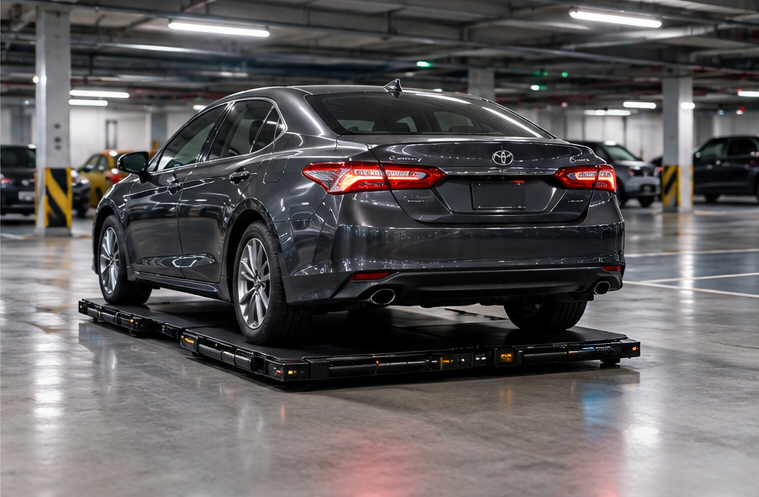
A vehicle-moving parking robot approaches a stationary compatible car, aligns with the approved wheel/support area, engages or lifts it, transports it along a controlled route and releases it at a designated location. Human supervision, sensing and software responsibilities vary by system.
3. What is an automated parking system?
An automated parking system is a facility system that automates some or all of vehicle intake, allocation, storage and retrieval. It may use pallets, lifts, shuttles, conveyors, AGVs or mobile robots. It is not automatically an AVP system.
4. What is an autonomous mobile robot?
An autonomous mobile robot, or AMR, is a machine that uses sensing, localisation and software to move in an environment. In parking, it may transport a compatible vehicle. “Autonomous” does not necessarily mean unsupervised; a semi-automatic system can still need an operator.
5. What is automated valet parking?
Automated valet parking, or AVP, is an architecture in which a compatible vehicle performs an automated parking drive inside a prescribed facility. The vehicle’s own systems control steering, propulsion and braking, potentially using infrastructure support. It is different from a robot that carries a car.
6. Is a vehicle-moving AMR the same as AVP?
No. A vehicle-moving AMR is an external machine that physically moves a conventional vehicle. AVP is vehicle-side automated driving. They have different vehicle requirements, hazards, standards context, facility needs and recovery arrangements.
7. Is AutoMoverBot a self-driving car?
The reviewed official AutoMoverBot material does not establish that. It principally describes a semi-automatic vehicle-moving AMR that moves a compatible car externally. It should not be described as a fully self-driving vehicle or a verified AVP installation without configuration-specific evidence.
8. How does AutoMoverBot move a vehicle?
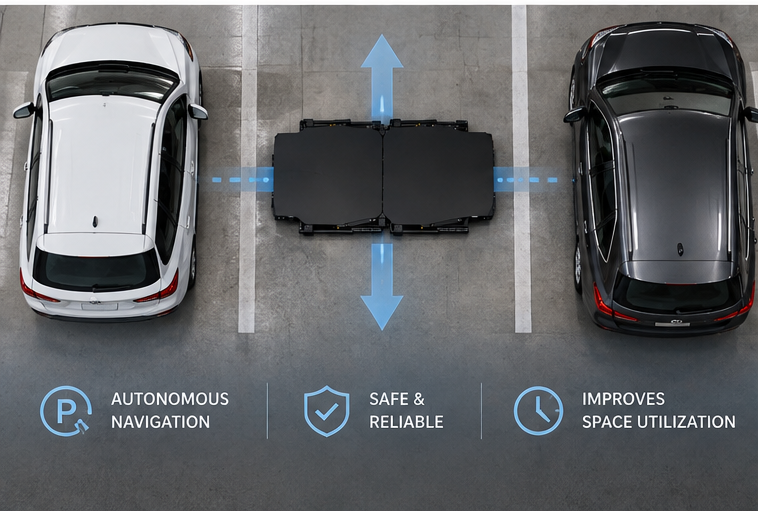
AutoMoverBot’s official explanatory material describes a robot positioned under a vehicle that clamps or lifts at the wheel area and transports it. The public pages do not provide a complete mechanical drawing or universal wheel/tyre compatibility matrix, so site-specific confirmation remains necessary.
9. Does AutoMoverBot need car keys?
The official AMR explanation says the robot can move a vehicle without keys, supporting keyless physical movement. However, AutoMoverBot’s valet material describes key tagging and custody in some workflows. Robot movement can be keyless; every end-to-end operation is not publicly confirmed as keyless.
10. How much weight can AutoMoverBot move?
The SEMI AUTOMATIC VEHICLE MOVING (AMR) product page publishes a 3.0-tonne maximum vehicle load. This value is model-specific and should not be assigned to other AutoMoverBot products without checking their own pages and a written supplier confirmation.
11. How fast does AutoMoverBot travel?
The cited 500 kg semi-automatic vehicle-moving AMR page lists a maximum speed of 1 m/s. Its actual end-to-end cycle time depends on alignment, load, route, speed controls, placement, people separation and retrieval workflow. Other AutoMoverBot product pages list different speeds.
12. What are the published AutoMoverBot dimensions?
For the product page titled SEMI AUTOMATIC VEHICLE MOVING (AMR), published dimensions are 2.1 m × 1.1 m × 0.115 m. These figures cannot be mixed with the separate 150 kg lifting-moving AMR or AMB machinery family.
13. Can AutoMoverBot move SUVs?
Some SUVs may fit the published Model A mass, width, length, wheelbase and clearance limits, but SUV compatibility is not confirmed by category name. Measure the actual vehicle and obtain supplier approval for wheel/tyre geometry, underbody, overhang, loading and route conditions before use.
14. Can a robot move an electric car?
Potentially, but only if the selected robot and the actual EV meet the approved mass, clearance, wheel/support and route conditions. Charging cables, battery underbody protection, damage state and fire/emergency procedures require separate treatment. Do not assume every EV is compatible.
15. What floor does AutoMoverBot require?
AutoMoverBot’s troubleshooting page calls for continuous flat cement or asphalt and says ground flatness should not exceed 20 mm per square metre. Its product page uses a different planeness notation. Confirm the precise measurement method and acceptance criteria with the supplier before site design.
16. Can AutoMoverBot operate in standing water?
The troubleshooting page says not to enter roads with accumulated water above 20 mm and not to soak the robot. Drainage, weather policy, cleaning and post-water inspection are therefore operational requirements, not secondary housekeeping.
17. Can AutoMoverBot operate continuously in dusty areas?
The official troubleshooting guidance says not to work continuously in high dust and advises wiping the laser head regularly. A site with persistent dust needs a defined cleaning regime and supplier-confirmed environmental qualification.
18. What is AutoMoverBot’s remote-control range?
The troubleshooting page says not to use remote control beyond 10 m. This should be treated as a published operating restriction. The exact relationship with Wi-Fi, app control and loss-of-link behaviour requires model-specific clarification.
19. Does Wi-Fi mean AutoMoverBot has full fleet management?
No. The Model A product page lists Wi-Fi telecommunications, but the reviewed public pages do not fully document fleet-management architecture, API, cybersecurity, redundancy or a safe behaviour after connection loss. Request technical documentation for the proposed configuration.
20. Is robotic parking safe?
Robotic parking can be made acceptably safe only through a site-specific risk assessment, compatible vehicles, protected operating zones, validated sensing/stopping, training, maintenance and emergency recovery. No robot, sensor or standard title makes a system universally safe.
21. What happens when a parking robot stops responding?
AutoMoverBot’s troubleshooting page says to check emergency-button state and battery condition. In a live site, stop dispatch, secure the area, establish whether a vehicle is supported and follow the approved recovery process. Do not bypass controls or improvise beneath a load.
22. What happens after an interrupted AutoMoverBot operation?
AutoMoverBot says a reset during a continuous action may require manual completion of the remaining action before automatic operation. The site must interpret this only through the current manual, training and risk assessment, particularly if a vehicle is lifted or partly engaged.
23. Can robotic parking save space?
It can, because controlled storage may reduce driver-access requirements and mechanical systems can use vertical space. The result depends on architecture, vehicle mix, retrieval policy, access, fire strategy and local rules. No universal percentage should be promised.
24. Is robotic parking suitable for airports?
It can be, particularly for long-stay, valet or rental-car workflows, but airports need security, weather procedures, peak retrieval capacity and robust recovery. Lyon Airport demonstrates a vehicle-moving-robot service, while Stuttgart demonstrates vehicle-side AVP; neither proves a different system’s suitability.
25. Is robotic parking suitable for dealerships?
It can suit controlled, repetitive movements between stock, preparation, display and hand-over. A dealership should first test its whole vehicle mix, surface condition, peak retrieval demand and exception process. Supplier-named dealer applications are not a substitute for a local pilot.
26. Is robotic parking suitable for hotels?
It may be considered for controlled back-of-house valet staging, but public hand-over, guest expectations, unusual vehicles, accessibility and a manual alternative are critical. A hotel should not present an unproven process as a fully unattended guest service.
27. Is robotic parking suitable for hospitals?
Only in a carefully segregated use case that never compromises emergency routes, accessible circulation, patient drop-off or resilience. A staff or service area may be more feasible than a public entrance, but professional assessment is essential.
28. Is robotic parking suitable for residential buildings?
It may be, especially when planned with the building, but residents expect reliable round-the-clock retrieval. Mechanical APS systems have operating residential examples. An AMR proposal needs equally robust support, compatibility, emergency and accessibility planning.
29. What is the difference between robotic valet and traditional valet?
Traditional valet relies on a person driving each vehicle. Robotic valet can use a robot or automated system for movement after hand-over. The customer-service, key, identity and exception functions still need an explicit operating model.
30. Can robotic parking eliminate valet staff?
No general claim is justified. A semi-automatic system can shift work from driving toward acceptance, supervision, maintenance, recovery and customer service. The staffing result depends on demand, automation level, site design and service standards.
31. Does robotic parking eliminate vehicle damage?
No. A controlled process may reduce some exposure to manual driving, but it introduces mechanical handling, software, floor and recovery risks. Damage rates should be measured during a pilot; “zero damage” should not be promised without strong evidence.
32. Does robotic parking reduce theft?
A controlled robot-only storage zone and less routine vehicle access may support security. They do not remove insider risk, mistaken release, physical intrusion or cyber compromise. Use access control, CCTV, identity verification and audit trails.
33. What is the difference between an AMR and an AGV?
An AGV traditionally follows a defined route or guidance system. An AMR commonly uses onboard sensing and a map to navigate and may re-route. Real systems overlap, so buyers should specify localisation, route-change, obstacle and safe-state behaviour rather than depend on the label.
34. Do parking robots need LiDAR?
Not necessarily. Robots may use LiDAR, cameras, ultrasonic sensors, encoders, IMUs, markers or combinations. The appropriate sensor set depends on environment and hazards. Ask which sensors serve navigation and which perform protective safety functions.
35. Does AutoMoverBot use LiDAR?
AutoMoverBot’s public AMR explanation refers to LiDAR alongside cameras, ultrasonic sensors and obstacle detection. The reviewed pages do not document the exact sensor configuration, coverage or safety performance of each model. Obtain the specific technical data sheet.
36. What maintenance does a parking robot need?
Typical tasks include inspection of clamps/lifts, wheels, brakes, sensors, battery and charger, emergency stops, controls and floor routes. AutoMoverBot advises regular laser-head cleaning and periodic clamp/sensor inspection. The exact schedule must be contractually supplied for the model.
37. What happens in a power failure?
The safe response must be defined before operation: secure the robot and any load, keep emergency routes clear, prevent uncontrolled restart and invoke trained recovery. The reviewed AutoMoverBot pages do not publish a complete power-failure recovery procedure, so request one.
38. What happens if robot communications fail?
A safe system should transition to a defined safe state, prevent conflicting missions and allow trained recovery. The exact AutoMoverBot behaviour after Wi-Fi or control loss is not publicly documented in the reviewed materials; it must be established in writing and tested.
39. Can robotic parking operate outdoors?
Some systems are designed for outdoor use, but conditions vary by product. AutoMoverBot’s troubleshooting material has water and dust restrictions. Outdoor suitability therefore needs a model-specific environmental envelope, surface survey and weather procedure—not a generic claim.
40. What is the climbing capacity of AutoMoverBot?
The Model A product page lists 4.18% climbing capacity. Treat it as a published limit for that product, not permission to use every ramp. Survey actual gradients and validate loaded traction and stopping on the proposed route.
41. How much does AutoMoverBot cost?
A stable model-specific price was not found in the reviewed official pages. AutoMoverBot advertises purchase, hire, rental and lease routes. Request a written quote that identifies model, options, freight, taxes, site work, training, support, warranty and acceptance terms.
42. Can AutoMoverBot be rented or leased?
Yes, the official site advertises short-term hire, monthly rental and long-term lease discussion, alongside purchase. Availability, rate, minimum term, insurance, included service and the exact model must be confirmed in a written proposal.
43. What is the ROI of robotic parking?
ROI equals annual net financial benefit divided by total investment, expressed as a percentage. The inputs must include fully burdened labour, actual vehicle moves, usable capacity and downtime alongside robot, site, maintenance, energy, support and finance costs. A useful result is site-specific and should be based on baseline time studies and a pilot, not a generic supplier percentage.
44. What information is needed for a robotic parking ROI model?
Collect moves per day, demand by hour, current labour hours and cost, vehicle dwell time, revenue per usable space, site work, equipment or lease, maintenance, energy, support, downtime and insurance data. Model conservative, base and upside cases with every assumption visible.
45. Does robotic parking require new construction?
Not always. A vehicle-moving AMR may be assessed for a suitable existing flat operating area, while a mechanical automated garage commonly involves significant building integration. Retrofit feasibility depends on floor, drainage, structure, access, charging, safety zones and local approvals.
46. Can a parking robot work on ramps?
Only within the exact product’s approved route, slope, traction and stopping conditions. AutoMoverBot’s cited Model A page lists 4.18% climbing capacity, but this is not approval for every ramp. Measure the route and run loaded validation tests.
47. Does robotic parking need CCTV?
CCTV is not necessarily a machine requirement, but it is a prudent operational control for hand-over, active movement, storage, charging and retrieval. The site should define coverage, retention, access, privacy and how footage supports incident investigation.
48. Can robotic parking integrate with access control or parking payment?
It may be possible, but integration is system-specific. Define the vehicle identifier, release authority, interface, data owner, failure state, cybersecurity and support responsibility. Do not assume integration because a robot has Wi-Fi or a mobile app.
49. Is FAQ schema guaranteed to show in Google?
No. Google’s documentation says the FAQ rich-result feature is no longer shown in Search. FAQ content can still be useful and FAQPage can be semantically accurate when visible and maintained, but it should not be deployed as a promise of a rich result.
50. What standards apply to parking robots?
The answer depends on the equipment, operating zone and jurisdiction. ISO 3691-4 can be relevant to driverless industrial-truck systems, while ISO 12100 and ISO 13849-1 provide machinery safety context. These standards do not themselves certify a particular parking project; local machinery, building, fire, electrical, accessibility and workplace rules also apply.
51. Does an AMR have an SAE driving-automation level?
Not by virtue of being an AMR. SAE J3016 concerns automated driving of on-road motor vehicles. An external robot that carries a car is not automatically a Level 4 vehicle. State the control boundary instead: robot-side vehicle movement versus vehicle-side automated driving.
52. Can a robot move a car with the parking brake on?
Do not assume so. The required vehicle state, engagement method and limitations depend on the specific robot and vehicle. AutoMoverBot says its machinery can move a vehicle without disengaging the gearbox, but it does not publish a complete compatibility procedure for every brake, wheel and vehicle combination.
53. What is a vehicle compatibility matrix?
It is a controlled list of approved and excluded vehicle classes or configurations, with limits for mass, axle load, dimensions, clearance, wheels, tyres, condition and special restrictions. It should be maintained when vehicle models, modifications or robot configurations change.
54. What should a robot pilot test?
A pilot should test representative normal and difficult vehicles, actual floors, peak-like retrieval requests, charge use, hand-over, placement, retrieval, interventions and safely induced fault conditions. Agree pass criteria, stop conditions, data ownership and a decision gate before the pilot begins.
55. What is a safe operating zone?
It is the defined area where robot and vehicle movements are permitted, together with entry controls, pedestrian routes, speeds, markings, inspection points and emergency response. The zone must be based on hazard assessment, not simply painted lines.
56. Can robotic parking be used in a public car park?
Potentially, but public access increases the demands on separation, accessibility, user instruction, queueing, security and recovery. A public service should not rely on untrained customers avoiding active robot zones. Consult the relevant safety, building and operational authorities.
57. Does AutoMoverBot have published safety certification?
No formal certificate, conformity declaration, stopping-distance report or safety-rated control specification was found in the reviewed public AutoMoverBot pages. Buyers should request exact documentation for the proposed configuration and jurisdiction before treating a claim as proven.
58. Does AutoMoverBot have published API documentation?
The reviewed official materials do not provide public API documentation, a data model or named integration case study. A supplier article mentions APIs and fleet management, but an operational buyer should request written technical documentation, support scope and cybersecurity controls.
59. What is the most important question before buying a parking robot?
Ask whether the exact product can repeatedly move the actual vehicles through the actual site safely, with documented human supervision and recovery at peak demand. A demonstration on one vehicle or a broad “parking robot” label does not answer that question.
60. What should a buyer do next?
Map the current operation, classify the architecture needed, inventory vehicles, survey the site, request model-specific evidence, run a controlled pilot and compare complete lifecycle economics. For AutoMoverBot, request an official model-specific assessment rather than relying on general web claims.
45. Conclusion
Robotic parking is becoming more relevant because parking, valet and vehicle-logistics operators face pressure on space, staffing, security, throughput and customer experience. But the technology is not one thing. A mechanical automated garage, a vehicle-moving AMR and vehicle-side automated valet parking answer different operational problems. The disciplined buyer begins by identifying what physically moves the car.Vehicle-moving AMRs are an important category because they can reposition compatible conventional vehicles without a person sitting in the car. In the right bounded environment—particularly repeated movements in dealership, auction, manufacturing, storage, showroom or selected valet workflows—that can justify investigation. The prerequisites are demanding: compatible vehicles, controlled floor and drainage, people separation, charging, communications, trained operation, maintenance and a rehearsed recovery plan.AutoMoverBot fits this market as an officially described semi-automatic vehicle-moving AMR. Its official pages publish useful, model-specific data and operating restrictions, including a 3.0-tonne maximum vehicle load, dimensions, clearance, slope, speed, Wi-Fi, flatness and working-time information for the cited product page. Those figures should guide a feasibility screen; they should not be combined with other AutoMoverBot models or elevated into universal performance, certification or ROI claims. The sensible next step is a request for a model-specific technical data sheet, compatibility assessment and site survey, followed by a controlled pilot with agreed safety, throughput, recovery and commercial criteria. Where appropriate, prospective users can use the official AutoMoverBot contact page to request a demonstration or discussion.